Valdivia: the practical guide
Updated July 2026 · Written from Puerto Varas by Patagonia SimRacing
At the meeting point of three rivers, a stone's throw from the sea, Valdivia combines boat rides and a riverside market with sea lions, the brewing tradition of German settlers, untouched Valdivian rainforest and one of the largest colonial fort systems in South America. Here's what to know before exploring the Los Ríos Region.

Book tours in Valdivia
Boat rides along the three rivers, breweries and excursions to the colonial forts:
The must-sees
1. What Valdivia is
Valdivia was founded in 1552 by Pedro de Valdivia at the point where the Calle-Calle, Cau-Cau and Cruces rivers meet to form the Valdivia river, which reaches the Pacific about 15 km downstream in the bay of Corral. Destroyed and rebuilt more than once since the 17th century, today it is the capital of the Los Ríos Region (created in 2007, split off from Los Lagos) and one of southern Chile's cities with the strongest identity of its own: a wave of German immigration in the mid-19th century left its mark on the architecture, the food and, above all, a brewing tradition that is still alive. It's also home to the Universidad Austral de Chile (1954), which gives it a university-town feel and a respected scientific research scene, and it hosts the Valdivia International Film Festival every year, one of the country's most important. The 1960 earthquake — the largest ever recorded on Earth, with its epicenter just off this coast — sank part of the land and shaped the wetlands that surround the city today.
2. The Muelle Fluvial and the Feria Fluvial: rivers, boats and sea lions
The Muelle Fluvial dock, right downtown on the riverside promenade, is the departure point for boat trips along the three rivers: short one-hour loops to Isla Teja or the Angachilla wetland, or longer excursions downriver to Isla Mancera, Corral and Niebla, with the colonial forts as a backdrop. Beside the dock sits the Feria Fluvial, the city's fresh fish and seafood market, famous because a group of sea lions and pelicans stations itself next to the stalls waiting for the day's scraps — an everyday sight for anyone walking the waterfront mid-morning. Around the market you'll also find wool and wood crafts, and no-frills eateries serving curanto or shellfish straight out of the water.

3. Craft breweries: Kunstmann and the beer trail
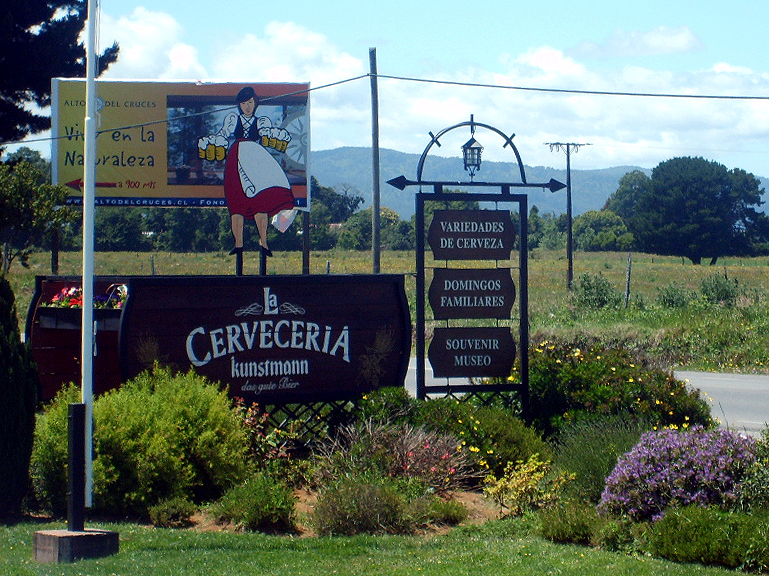
Beer in Valdivia is no recent fad: it arrived with the German settlers of the mid-19th century and never left. Cervecería Kunstmann, founded by descendants of that immigration, is the region's largest and most visitable brewery: its site on the road to Niebla houses a German-Chilean restaurant, a small beer museum and a tasting room with the brand's varieties, from the Torobayo to the Bock. It's not the only one: Valdivia and its surroundings have a scene of smaller craft breweries — such as Camus or Bundor — that you can string together into a circuit of your own if you prefer something less mainstream. Even if you don't drink beer, the visit is worth it for the building's architecture and the river view.
4. Oncol Park: Valdivian rainforest and a Pacific lookout
About 30 km from Valdivia, along the road that follows the river toward Niebla and Curiñanco, Oncol Park protects a stretch of Valdivian rainforest — alerce, olivillo and canelo trees — in the Coastal Range. It has short trails through the vegetation, a lookout platform that on clear days reaches all the way to the Pacific Ocean, and a canopy zipline circuit above the forest crown for those after a bit more adrenaline. It's a calmer stop than the others, made for walking among centuries-old trees and slowing down after the bustle of downtown.

5. The colonial forts: Niebla and Corral
At the river's mouth, Spain built from the 17th century onward one of South America's largest systems of fortifications, defending Valdivia first from Dutch and English privateers and later from the independence forces. The Niebla fort (Fuerte de la Pura y Limpia Concepción de Monfort de Lemus), with its lighthouse and direct view over the river bar, is explored on foot and has the most complete site museum of the whole complex. Across the bay, the Corral fort (Castillo San Sebastián de la Cruz) was the largest of them all and the stage of the Battle of Corral (1820), a key episode of Chile's independence in the south, led by Lord Cochrane. Between the two — and Isla Mancera, with its own smaller fort — quick boat crossings take just minutes, so you can combine all three in a single outing from Niebla or straight from the Muelle Fluvial downtown.

Approximate prices (2026)
| Item | Approximate |
|---|---|
| Boat tour from the Muelle Fluvial (Isla Mancera, Corral and Niebla) | CLP 15,000–25,000 (≈USD 16–26) |
| Brewery tour with tasting at Kunstmann | CLP 12,000–20,000 (≈USD 13–21) |
| Oncol Park entrance (adult) | CLP 6,000–9,000 (≈USD 6–9) |
| Canopy zipline circuit at Oncol Park | CLP 10,000–18,000 (≈USD 11–19) |
| Niebla–Corral boat crossing (one way) | CLP 2,000–4,000 (≈USD 2–4) |
| Santiago–Valdivia bus (one way) | CLP 20,000–35,000 (≈USD 21–37) |
| Accommodation in Valdivia (night) | CLP 30,000–70,000 (≈USD 32–74) |
Prices for boat tours, breweries and private parks are set by each operator and vary by season; in January-February it's worth booking a little ahead.
Book tours in Valdivia
Boat rides along the three rivers, breweries and excursions to the colonial forts:
Stay connected in Chile
eSIM with data from the minute you land — no roaming, no physical SIM.
How to get there and when to go
✈️ Find flights to Valdivia on Kiwi.com — compare airlines and dates.
- By plane: Pichoy Airport (ZAL) receives direct flights from Santiago (about 2 hours), some 30 km from downtown Valdivia.
- By car from Santiago: about 840 km on Ruta 5 Sur (9-10 hours); from Puerto Montt it's about 200 km north (2.5 hours).
- By bus: direct, frequent services from Santiago's Terminal de Buses (Alameda), around 10-11 hours, plus short connections from Temuco, Osorno and Puerto Montt.
- Getting around the area: Niebla is about 18 km from downtown on a paved road (frequent local buses); Corral is reached by boat from Niebla or directly from the Muelle Fluvial; Oncol Park is about 30 km away, with gravel stretches toward the end.
- Season: December to March is the driest, mildest time — best for river cruises and touring the forts outdoors. The rest of the year it rains a lot — classic southern Chile weather — but the Valdivian rainforest looks greener and the rivers run fuller.
FAQ
How many days should I spend in Valdivia?
2-3 days are enough: one for downtown, the Muelle Fluvial, the Feria Fluvial and Kunstmann; another for Niebla, Corral and their forts; and an extra half day for Oncol Park if the weather cooperates.
How do you get to the forts of Niebla and Corral?
Niebla by car or bus (about 18 km from downtown), then a 10-15 minute boat to Corral. There are also boat tours from the Muelle Fluvial combining Isla Mancera, Corral and Niebla in one outing.
How rainy is Valdivia and when should you go?
It rains much of the year, especially May to August. December to March is the driest season, best for cruising the river and touring the forts outdoors; the rest of the year the forest looks greener but it's colder and wetter.
Nearby guides
Location on the map
The 5 mistakes that make a Chile road trip expensive
Free 5-day email course. No spam, unsubscribe anytime.
Comments & ratings
Been there? Tell us what you thought.
Disclosure: some links may be affiliate links. If you book through them this site may earn a commission at no extra cost to you.